Showing posts with label wildlife. Show all posts

Monday, September 19, 2011

Workshop: Woodlot Management

Introduction to Woodlot Management

Saturday, September 24, 2011

9am-3pm

Glen Orchard Public School


If you are planning to harvest trees from your woodlot, have an interest in what information is available on woodlot management, are wondering how you might manage your woodlot for wildlife values, or would like to learn more about the design and maintenance of trails through your woodlot, then this is the workshop for you!


Participants will learn about basic principles of forest management, how to assess trees for defects, what wildlife values exist in woodlots, as well as some basic principles of trail design and maintenance.


The morning session will consist of several short lectures followed by an afternoon field trip with real examples and hands on learning.

This workshop is limited to 35 participants. Pre-registration is required. For information and registration please contact Meghan Powell at the Ministry of Natural Resources, Bracebridge Office. Tel: 705-646-5500 or email, meghan.powell@ontario.ca


Top photo by John McQuarrie.

2nd and 3rd photos by Greg Francis

Wednesday, May 4, 2011

Composting 101

Get a high quality soil conditioner to improve your garden!

Reduce household waste by up to one third!

COMPOST!!


What is compost?


According to the Compast Council of Canada, composting is a natural biological process, carried out under controlled conditions, which converts organic material into a stable humus-like product called compost. During the composting process, various microorganisms, including bacteria and fungi, break down organic material into simpler substances. Composting is an aerobic process, meaning that the microorganisms require oxygen to do their work.


Benefits of Composting:


*Compost helps to maintain a healthy soil pH so that plants grow better

*Compost helps plants cope with stresses from drought and frosty temperatures

*Compost helps improve texture of soil

*Compost helps increase a sandy soil's moisture holding capacity
*
Compost keeps earthworms content so that they can go about their work of aerating the soil

*Compost is a great source of plant nutrients


A special nod to coffee:

Coffee grounds fit the standards set by gardeners for compost materials. The grounds, when mixed with soil, release nutrients that make the ground richer and more acidic. Plants that flourish in acidic soil will be healthier since they can get the needed nourishment from the ground. If you have a good supply of coffee grounds, just spread them evenly in your garden. Your plants will reward you by producing robust blooms.


*New for Muskoka: Visit Oliver's Coffee (Bracebridge, Port Carling, or Bala) for your free bucket of grounds.


Worried about wildlife?

*Don't compost food scraps. Use a worm bin (i.e. vermicomposting) indoors instead. Or bury your food scraps directly in the garden, about a foot below the soil's surface.


*Make sure your compost pile doesn't smell. Strong odors attract pests. Odors in a compost pile are the result of anaerobic activity, which means your pile is compacted or too wet and air can't reach all of the materials. Be sure to turn it regularly to avoid this problem.

Not a gardener?

If you can't use the compost in your garden, you can still compost! Most communities in Muskoka offer curbside compost pick-up. If you just can't generate enough compost, some towns offer days where compost material is available for pick-up for use in your garden.

Want to know more?


Peterborough Green-Up Fact Sheets: a whole series on composting!!

Environment Canada: Composting Tips


Green Action Centre (Manitoba) has some good information

Monday, April 4, 2011

Signs of Spring

Spring was definitely in the air this weekend!

What did you do to enjoy it?

Did you remember your camera?


I noticed some sure signs of spring when I was out during the past week:

The ice is melting and shifting on Lake Rosseau


New growth and buds on this Red Maple in Annie Williams Park, Bracebridge

The river is free of ice, most of the snow has melted, and buds are starting to appear on the trees in Annie Williams Park in Bracebridge.

All the details you need to enter the "Spring to Life" Photography contest can be found here or on the blog post from last week.

There are some great prizes! Deadline for entry is this Friday, April 8, 2011

Thursday, March 31, 2011

Spring to Life! Photo Contest


A celebration of Muskoka’s environment and the global Earth Hour and Earth Day initiatives.

Frogs, toads, snakes, and turtles emerge! Photo Rebecca Francis


Scour your backyard, nearby lakes, swamps, woodlands, and neighbourhoods for the unique found-only-in Muskoka shot of the local environment as it comes to life after a long, sleepy winter.


What we're looking for are photographs that exemplify the signs of spring in Muskoka. What comes to mind when you think of spring? What feelings do you experience when "spring is in the air"?


Critters like chipmunks come out and robins and red-winged blackbirds return. Swollen buds take over the tips of branches and clothes can be hung on the line. For each person spring shows up in different, subtle ways. Photograph submissions should reflect your personal experience of the transition from winter to spring- and our enjoyment of that special time. The snow melts and we can once again see the forest floor. Ground covers sprout up and woodland pools foster lots of life. Photo: Rebecca Francis


1st Prize! An in-flight aerial photography lesson with professional photographer Paul Bennett. Visit http://www.paulbennettphotography.com/.


2nd Prize! A one-year subscription to the Wednesday edition of your choice, The Gravenhurst Banner, The Huntsville Forester or The Bracebridge Examiner.


3rd Prize! A one-year membership with the Muskoka Heritage Foundation and a copy of the MHF DVD entitled Life on the Edge: Stories of Muskoka’s Past.


Ducks and other birds return from their winter away. photo: Greg Francis


Criteria


  • Open to amateur photographers

  • Contest starts same day as Earth Hour— March 26

  • Entries must be submitted by 4:00 p.m. April 8

  • Email entry to events@muskokaheritage.org

  • Photos must be at least 300 dpi and 8 inches wide

  • To be eligible, submissions must include the name of the photographer and a brief description of the photo, including where it was shot in Muskoka

  • 1st, 2nd and 3rd prize photos will be published in the April 20th, edition of Metroland’s local Wednesday papers (The Gravenhurst Banner, The Huntsville Forester, The Bracebridge Examiner) - 2 days before Earth Day!

  • Winning photos will be published on the Muskoka Heritage Foundation website


  • Metroland Media Inc. and the Muskoka Heritage Foundation reserve the right to reproduce submissions

Get outside, take your shots, and enter soon!!


Sponsors


Wednesday, March 2, 2011

March Break Nature Retreat – Earth Mentoring

This week a profile of a very cool program in Muskoka: Earth Mentorship Programs


Earth Mentorship Programs runs a variety of programs designed to help participants learn valuable and comprehensive knowledge of the natural world through experiential activities, story telling and the application of ancient wilderness skills and bush craft. They also help implement land stewardship projects and write/approve Managed Forest Tax Incentive Program (MFTIP) plans.


Check out this cool video from the founder and main mentor, Chris Gilmour.


Earth Mentoring Programs are excite to offer the 3rd annual March Break Nature Retreat!

This retreat will offer you a chance to rejuvenate in nature’s beauty, deepening your connection to, and understanding of, the natural world. We will be expanding our awareness & knowledge, while exploring some of the many uses of nature’s gifts. Come learn new skills to bring back to the classroom or integrate into your life outside of work.


Activities Include:
- Studying Wildlife through the Eye of a Tracker
- Snowshoeing and Camp Fires
- Basket and Container Making with Natural Materials
- Wilderness Awareness Games/Activities
- Story Telling
- Wilderness Crafts with Natural Materials
- Intro to Earth Based Mentoring (coyote mentoring)
- Good Food & Good Fun


When: March 15 – 18, 2011 (March Break)
Where: Wolf Den Bunkhouse, Oxtongue, ON, 8 min West of Algonquin Park. Each participant will sleep in a beautful log cabin.
Food: We will provide healthy, wholesome dinners.Participants bring & prepare their own lunch & breakfast in the Wolf Dens communal kitchen.
Kids/Youth – If you have children you wish to bring along, arrangements may be made for nature based day care during the program. Please inquire.
Price: $360/person – Includes 3 nights accommodations,3 dinners, course materials, snow shoes extra if required

Contact Chris for more information or to register!

Or click on any of the photos to go to the Earth Mentorship website

Tuesday, March 1, 2011

Tree Trivia & Stewardship Conference

Globally, forests are host to 80 percent of our biodiversity.
Ten percent of the world's forests can be found right here in Canada.
And remember, the United Nations has declared 2011 the International Year of Forests.


photo: Greg Francis

Registration opens today for the 2011 Muskoka Stewardship Conference!
View the full agenda and register here
There will be speakers about the Managed Forest Tax Incentive Program, wildlife topics, native species gardening, water quality, and more!
It is an excellent change to learn more about stewardship in Muskoka and network with like-minded folks.
Hope to see you there!

Monday, February 14, 2011

Wood Duck Adventure

Who lives here?

Introducing the Wood Duck!
(Aix sponsa)

{A male wood duck on the left and a female on the right}
photo credit: Randolph Femmer


I wrote a couple of weeks ago about the Pileated Woodpecker and the importance of cavities. Wood ducks are one of the species that uses cavities made by pileated woodpeckers. However, wood ducks can also be induced to nest in artificial boxes.


Armed with this knowledge, an invitation from a landowner here in Muskoka, a cordless drill, a sharpie, and some wood shavings, a group of us headed out to see for ourselves if any nesting had taken place last spring on this property.
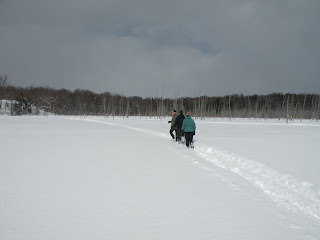
The incredible volunteers who accompanied me are none other than 3 of the Master Stewards from the Muskoka Stewardship Program. We were invited to this spectacular 100 acre property located in Muskoka to see if there had been any wood duck activity during the past year and prepare the boxes for this coming spring.


You see, wood ducks like to nest in cavities in wetlands because it makes it very difficult for predators to access their nests. These boxes are located in a 30 acre wetland. It's actually quite an amazing beaver pond. Normally inaccessible, the wood duck boxes had to be put up in winter and we needed the ice to be solid to change the material in the boxes for the coming spring.

Above: Paula unscrews the front of the box...you can see our shadows as we eagerly anticipate the contents of the first box!!
Female wood ducks often return to nest in the place where they were born. There is an increased chance they will use the boxes if they are not dirty from the previous year and also if the material inside is dry.
Our mission for the afternoon: clean out boxes, make observations on each one (amount of eggs inside, other animals that may have used it), and refill the boxes with new material. We also re-labelled the numbers on the 8 boxes from last year and assigned numbers to the 5 new boxes that were put up.
Inside each box the material is compacted down. There are often layers of broken shells and downy feathers. Notice the inside of the front piece that is sitting on the ground. The horizontal lines are carved in so the hatchlings can grab on to climb out before they fledge.
This box has quite a few shells and some feathers. In some of the boxes we could tell it was a wood duck because of the iridescent colour of the feathers.
A close up of the egg shell and some downy feathers.
Here is the crew, with our tools, in front of Box #5. Notice the oblong shape of the entry hole for the wood ducks. This shape is suited for them and is also big enough, but not too big. If you decide to put up boxes of your own, this is an important component. Also important is the forward slanted way they are affixed to the tree.
A beautiful day to get ready for spring and help the wood ducks have suitable nesting spots for when they return this spring. Perhaps we'll return next year to see how they did!

photo: Mike Sweet

Interested in building your own wood duck box?
Follow the same directions as the landowner whose property we visited!


Want to know more about wood ducks?
There are lots of websites:
Hinterland's Who's Who
House Construction Tips
Ducks Unlimited
The Wood Duck Society

Monday, January 24, 2011

RMR: Bear Tagging

I just came accross this and can't resist sharing even though it is from March of 2009. It features some Muskokans who work in Algonquin Provincial Park- and Rick Mercer of course.
Funny and amazing!
Enjoy and stay warm this week!

Thursday, September 2, 2010

Stewardship Series: Upcoming Workshops


As a landowner, you play a special role in maintaining the health of our province’s ecosystems. Land Stewardship is taking responsibility for our actions on our lands and waters; actions which directly influence land values for ourselves, our children and future generations. Our continued enjoyment of these values will require a better understanding of the natural systems on the land which supports them.


The Stewardship Series are workshops designed for anyone planning and conducting work projects on private lands. Participants will gain the knowledge and skills required to practice good land conservation through on the land investigations, resource sharing and networking with land stewardship experts.


Topics & Dates:

Management Options for your Woodlot: Friday, September 10, 2010
Wildlife in your Woodlot- Challenges of Co-existing: Friday, October 15, 2010
Maple Syrup- Operations & Opportunities: Friday, February 25, 2011
  • Workshops run from 9am-3pm
  • Cost: $25/person/day: includes lunch
  • rain or shine

See the brochure for more information.

Thursday, August 19, 2010

A beautiful beaver pond


I wanted to continue with the post from last week and show you some pictures from a recent Stewardship Program visit. These landowners are enthusiastic about what they are learing from the active beavers on their property.

Added benefit of letting nature do its' thing: a lot of other wildlife that uses this area! The owners love sitting in the gazebo by the pond at dusk watching all the activities. They are inspired by watching the pond and the wildlife it attracts. They have seen deer being chased by coyotes then seen the coyotes playing at the side of the property. In the winter their observations include a moose and her calf on the pond.


It just goes to show the different approaches that can be taken on different properties. A perceived problem can actually be a fantastic learning opportunity- and it is beautiful!

How do you enjoy watching fauna on your property?

Tuesday, July 27, 2010

Wildlife CSI

The last Nature Quest Workshop of the summer was put on today by John van Geene, Conservation Officer (C.O.) for the Ministry of Natural Resources. He spoke to the group about his job and the world of wildlife forensics. There were lots of skulls, pelts, and antlers on display and we spent some time outside in mock situations of examples of what John encounters when he is out in the field.
{John, in uniform with duty belt and the equipment he uses on the table behind him}


The job of a Conservation Officer is a tricky one. It involves the art of interacting with people and educating about why the laws are in place and how they are designed to help the natural world. It also means upholding the fisheries, hunting and land use laws on crown land and encouraging people to comply with these laws. The job of a conservation officers is mostly reactionary to tips called in by the public (1-877-TIPS-MNR). Officers also patrol throughout Parry Sound Muskoka district during moose and deer hunting seasons.
{moose skulls, antlers, and jawbones- the teeth are huge!}


For example, if a hunter has a tag to kill a cow moose, but instead kills a bull and is caught by a C.O. they could be fined and will most likely have the animal confiscated (the meat is donated to food banks). At the workshop, John explained that moose tags are issued based on a lot of research done on the moose population of Muskoka each year. There are different wildlife management areas in the province and the number of tags for bulls and cows depends on how strong the population is each year. John told us that populations can be threatened if hunters shoot more than they are allowed or not according to their tag. These laws exist to keep the populations stabilized. John reminded the group that humans are part of the natural world and the importance of balancing what we take and how our actions affect other animals and the ecosystem as a whole.
{a demonstration outside of a hunter who has a tag to kill a cow but killed a bull instead}

{John demonstrates the use of a live trap for raccoons as two workshop participants look on attentively- and test the trap!}


There is lots of fancy equipment that Conservation Officers use when they are out in the field and when collecting evidence to build a case against someone with an infraction. John had it on display for us. It includes:
  • a duty belt (pistol, handcuffs, baton, etc.)
  • walkie talkies
  • binoculars
  • spotting scope
  • whistle
  • compass, map & GPS
  • satellite phone
  • camera
  • truck
  • ATV
{John's truck with the ATV in the back. He even turned the lights on for us!}
Some of the most common infractions are:
  • not having a licence (fishing or hunting)
  • work on a shoreline that does not have a permit but requires one
  • commercial sale of animal parts (e.g. bear paws & gall bladders)
  • taking more than the allowable amounts (fish, wildlife)
  • hunting or fishing for species that are not in season
  • boating safety
John sees himself as an educator- of existing laws and their role in keeping a balanced natural environment. Adhering to these laws ensure that we are able to continue hunt, fish, and interact with the natural world. It is our responsibility to know the rules before heading out.

{wolf skulls and pelt}


{a beaver pelt, skull, and jaw bone}

Wednesday, July 21, 2010

Managing Your Woodlot for Wildlife

This week at the Nature Quest Stewardship Series workshop Jan McDonnell, biologist at the Ministry of Natural Resources, spoke to the group about considering wildlife when managing your woodlot. Whether you have several acres or a few trees in your yard, there are some things to think about so that we keep habitat and food for mammals, birds, amphibians, and insects. Mike Walsh then guided us on a walk at the Bracebridge Resource Management Centre where we got to see some examples of what we talked about with Jan. It was a fantastic afternoon!
Mast Trees
Oak, beech, cherry, basswood, hickory, butternut and walnut trees all produce fruit that animals feed on. Acorns are some of the highest in nutritional value and are eaten by many animals. Trees that produce fruit also tend to be genetically superior so it's good to keep them on your property to provide the seed for new trees. In Muskoka, black bears eat beech nuts to gain weight for winter. Bears will climb beech trees to eat the nuts. It's easy to tell if a bear has been climbing a beech tree because the bear leaves claw marks on the smooth bark like in the picture below. Bears won't climb just any beech tree though- they actually don't feel safe up there. Somehow they know which have the best nuts and go for those ones.
Snags

Snags are dead trees that are still standing. They provide nesting, food, hunting and resting places for many wildlife species. They are often full of cavities (see last week's post) created by pileated woodpeckers. While these woodpeckers create and use these cavities, they leave after using it once to create another. Other animals like wood ducks, chickadees, tree swallows, and owls then use the cavities. Often snags have other holes from where the canopy of the tree has fallen to the forest floor.

Downed Woody Debris

Speaking of the forest floor, the area surrounding snags often has fallen branches. This material is called downed woody debris and it also has considerations for habitat and overall forest health. When this wood rots, it provides nutrients that help replenish the soils of the forest and help regeneration. Resist the urge to "tidy up" the forest by removing this valuable part of the ecosystem. Wildlife also keys in on these fallen logs. Winter wrens, mice, chipmunks and other small mammals find little nooks to hide in. The invertebrate life on a fallen log is truly amazing- centipedes, mites, and ants scurrying about, beetle larvae gradually chomping the tough wood and microscopic organisms taking the wood down to its basic components. Fungi and mosses thrive here too! Not only is this valuable habitat, it is a food source for larger animals.


Woodland/Vernal Pools

Woodland pools (also known as vernal pools) are seasonally wet areas in the forest. They are usually low-lying and shaded under the canopy. Some stay wet year round and others dry up around mid-summer. They are often filled by the spring run-off. Woodland pools are fragile ecosystems that provide breeding ground for many amphibians as they begin their lives. Since they are void of fish, they are safe places for these species. For example, in Muskoka, the spring peepers we hear as one of the first signs of spring beginning their lives in woodland pools. Want to learn more? Go to the Ontario Vernal Pool Association.


As landowners, it is our job to works towards a better understanding of the different species that use our property. Looking to the trees in our yards and woodlots can provide lots of hints! It's easy to maintain habitat for wildlife, doesn't usually cost any money, and enhances the health of the forest and overall ecosystem.
What kinds of habitat are in your woodlot??